Research

Developing frameworks for effective Human-AI collaboration through multimodal analysis and cognitive modeling

Outcomes

Paper 1 outcome
Paper 2 outcome
Paper 3 outcome

Human-AI Collaboration in Forecasting Systems

Developing frameworks that enhance expert decision-making through synergistic human-AI interaction in time-series forecasting

Human-AI Collaboration in Forecasting Systems

Challenge

AI-only forecasting systems struggle under sparse data, unexpected events, and shifting regimes. Expert forecasters routinely adjust model outputs using domain knowledge, yet current systems rarely support structured collaboration between humans and AI. This research addresses the gap by designing collaboration frameworks that calibrate trust, expose model uncertainty, and enable principled human refinement of machine predictions in real-world electricity demand forecasting and related time-series tasks.

Methods

  • Built interactive decision support interfaces implementing an AI-first paradigm, where ML models produce initial forecasts that experts refine.
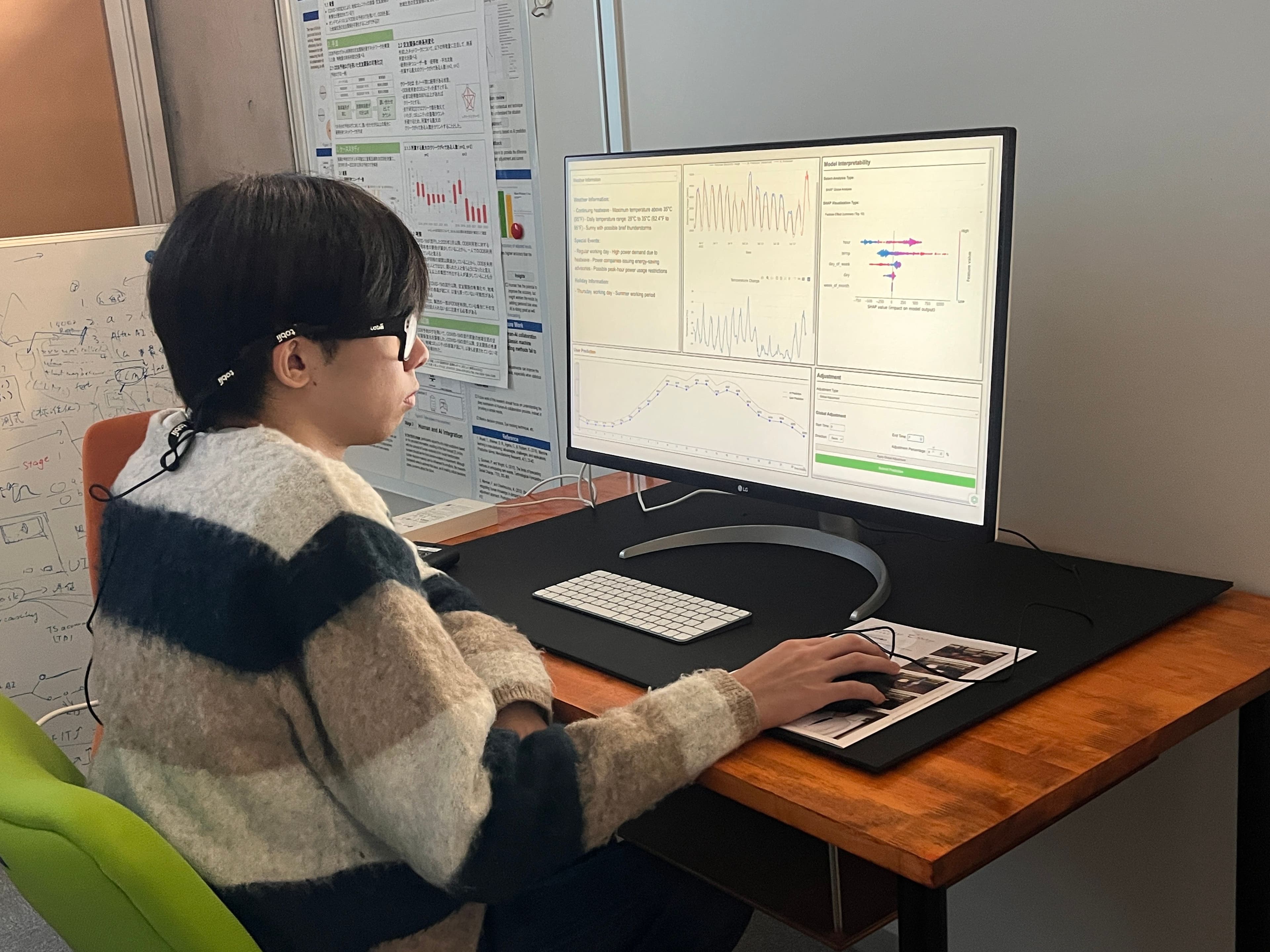
  • Collected multimodal behavioral signals (eye-tracking with Tobii Pro, mouse trajectories, screen interaction logs) during forecasting tasks.
  • Modeled cognitive state transitions and interaction strategies using sequence models (e.g., HMM/RNN/LSTM) over multimodal features.
  • Conducted controlled studies comparing collaboration strategies across participants with varied technical backgrounds and domain familiarity.

Results

  • Human-AI collaboration improved forecast accuracy under sparse/volatile conditions compared to AI-only baselines.
  • Participants with strong technical backgrounds were especially effective at augmenting AI predictions while managing over-adjustment risks.
  • Multimodal signals (gaze, mouse dynamics, interaction timing) revealed distinct decision strategies and informed adaptive interface design.
  • Findings consolidated into a human-centered collaboration framework; results disseminated via IJHCS submission and TE2025/INCOSE(CAS) acceptances.

Key Learnings

Effective collaboration requires transparent uncertainty communication, trust calibration, and support for strategy exploration. Multimodal behavioral data enables richer modeling of user cognition and can drive adaptive AI assistance. Designing interfaces that respect expert workflows is essential for achieving reliable, reproducible gains beyond algorithmic performance alone.

Related Publications

Submitted

Zhang, Y., Hiekata, K., Nakashima, T., Shao, Q. (2025). Towards a Predictive Human Partnership Framework: Designing AI-First Decision Systems with Human Refinement in Time-Series Forecasting International Journal of Human-Computer Studies.

This paper presents a novel framework for Human-AI Collaboration in forecasting systems, proposing an AI-first paradigm where machine learning models generate initial predictions that experts refine through interactive interfaces. We conducted user studies with 25 participants and demonstrate significant improvements in forecast accuracy and user trust.

Accepted

Zhang, Y., Hiekata, K., Nakashima, T., Shao, Q. (2025). Bridging Human Cognition and AI Systems: A Transdisciplinary Engineering Study of Temporal Interaction Patterns in Collaborative Forecasting Proceedings of the 32nd International Conference on Transdisciplinary Engineering (TE2025). PDF

This study addresses the critical need to understand human-AI collaboration as artificial intelligence becomes increasingly integrated into various aspects of daily life beyond purely technical domains. The authors explore how human adjustments to AI predictions, particularly in judgmental forecasting studies, can sometimes lead to better outcomes than AI-only systems. This highlights the transdisciplinary engineering approach taken to analyze temporal interaction patterns in collaborative forecasting involving both human cognition and AI systems.

Accepted

Zhang, Y., Shao, Q., Hiekata, K., Nakashima, T. (2025). Multimodal Analysis of Human-AI Collaboration in Adaptive Forecasting in Electricity Demand Prediction INCOSE Complex Adaptive Systems Conference.

As AI technologies advance, human-AI collaboration in adaptive systems becomes crucial for strategic decision-making, particularly in complex tasks like electricity forecasting under uncertainty. This study introduces a transdisciplinary approach to investigate human-AI collaboration, focusing on how multimodal data reveals intricate decision-making patterns. Using Tobii Pro Glasses 3 for eye-tracking, the experiment captured participants' detailed visual attention data along with user interaction logs within a Decision Support System (DSS) designed for real-world electricity forecasting tasks. Previous research has highlighted the importance of human intervention in improving AI predictions, but the underlying mechanisms remain unclear. Multimodal data analysis allows us to reconstruct users' interactive behaviors and decision-making processes when interacting with AI-generated forecasts, highlighting their responses and strategies throughout the experiment. The core contributions of this study include: (1) demonstrating the effectiveness of eye-tracking and interaction log data in capturing individual collaborative behaviors during human-AI interaction; and (2) mapping users' strategic decision-making pathways, illustrating how they adjust their responses based on AI assistance. The insights from this study provide valuable guidance for designing adaptive DSS interfaces that can better facilitate human collaboration with AI in industrial decision-making, driving advancements in strategic planning under dynamic conditions.

Multimodal Behavioral Analysis for AI Systems

Leveraging eye-tracking and interaction patterns to understand and predict user cognitive states during AI-assisted decision-making

Multimodal Behavioral Analysis for AI Systems

Challenge

Understanding user cognition during AI-assisted decision-making demands signals beyond self-report and coarse interaction counts. To design adaptive AI systems, we need fine-grained, synchronized measurements of attention, uncertainty, and strategy shifts derived from eye movements, mouse dynamics, and temporal interaction patterns.

Methods

  • Integrated Tobii Pro Glasses/SDK for real-time gaze capture during interactive forecasting tasks.
  • Engineered mouse-trajectory and timing features to detect hesitation and uncertainty.
  • Built sequence models (RNN/LSTM/HMM) on multimodal features to infer cognitive states and strategy transitions.
  • Developed analysis dashboards to visualize gaze distributions, interaction flows, and pattern clusters across sessions.

Results

  • Identified distinct collaboration strategies reflected in gaze allocation, adjustment magnitude, and timing behavior.
  • Multimodal features reliably indicated moments of uncertainty and over-adjustment risk, informing adaptive UI cues.
  • Findings presented in ATDE 2024 and extended in INCOSE(CAS) 2025; insights guide design of adaptive interfaces for industrial forecasting.

Key Learnings

Multimodal data enables robust modeling of user cognition but requires careful synchronization, feature design, and privacy-aware handling. Expertise and domain familiarity strongly mediate collaboration outcomes, suggesting interfaces should adapt assistance based on user state and strategy.

Related Publications

Published

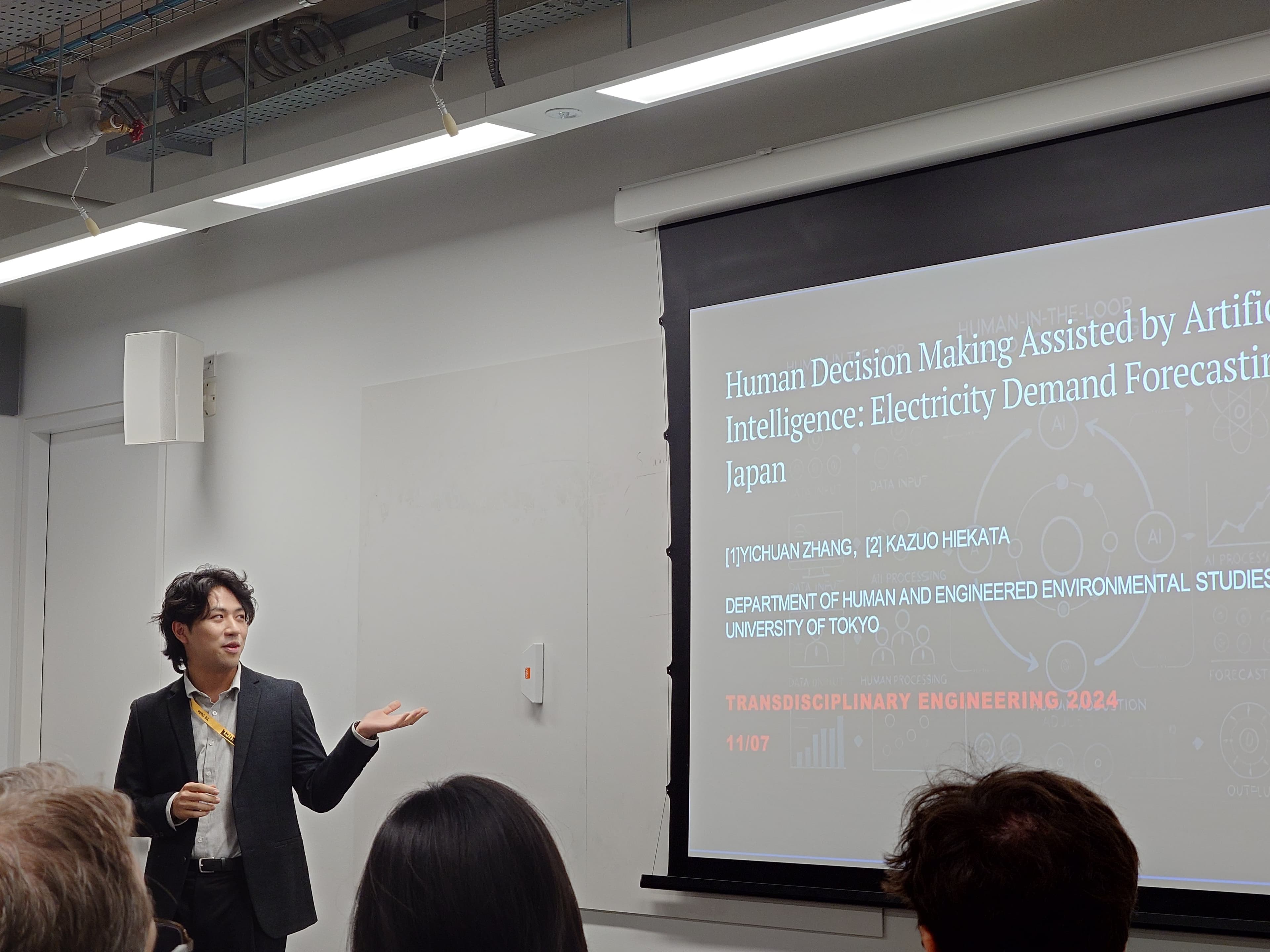
Zhang, Y., Hiekata, K. (2024). Human Decision Making Assisted by Artificial Intelligence: Electricity Demand Forecasting in Japan Advances in Transdisciplinary Engineering. DOI

Transdisciplinary engineering fosters innovative solutions by bridging gaps between diverse fields of expertise. This study explores the synergy between human expertise and artificial intelligence in the domain of electricity forecasting. Accurate prediction of electricity demand is a crucial component of sustainable engineering practice, especially in energy-intensive economies like Japan. This research addresses the pressing challenge of using algorithmic predictions in future electricity demand forecasting, particularly the shortfalls of AI-driven forecasts when dealing with sparse datasets and unforeseen events. By revisiting actual historical cases of Tokyo's electricity demand and providing participants with foundational industry knowledge and an interactive data analysis interface, the study collected comprehensive data on forecasting tasks from individuals with both technical and non-technical backgrounds during user experiments. Findings indicate that human-AI collaboration can significantly enhance forecast accuracy under specific conditions. Significant improvements were observed when AI predictions were constrained by data limitations and unexpected events. Furthermore, individuals with strong technical backgrounds excelled in augmenting AI forecasts, despite the risks of human bias and over-adjustment. The study confirms the benefits of a human-AI collaborative model and identifies potential strategies for AI to better support human decision-making in energy engineering.

Publications

Submitted

Zhang, Y., Hiekata, K., Nakashima, T., Shao, Q. (2025). Towards a Predictive Human Partnership Framework: Designing AI-First Decision Systems with Human Refinement in Time-Series Forecasting International Journal of Human-Computer Studies.

This paper presents a novel framework for Human-AI Collaboration in forecasting systems, proposing an AI-first paradigm where machine learning models generate initial predictions that experts refine through interactive interfaces. We conducted user studies with 25 participants and demonstrate significant improvements in forecast accuracy and user trust.

Accepted

Zhang, Y., Hiekata, K., Nakashima, T., Shao, Q. (2025). Bridging Human Cognition and AI Systems: A Transdisciplinary Engineering Study of Temporal Interaction Patterns in Collaborative Forecasting Proceedings of the 32nd International Conference on Transdisciplinary Engineering (TE2025). PDF

This study addresses the critical need to understand human-AI collaboration as artificial intelligence becomes increasingly integrated into various aspects of daily life beyond purely technical domains. The authors explore how human adjustments to AI predictions, particularly in judgmental forecasting studies, can sometimes lead to better outcomes than AI-only systems. This highlights the transdisciplinary engineering approach taken to analyze temporal interaction patterns in collaborative forecasting involving both human cognition and AI systems.

Accepted

Zhang, Y., Shao, Q., Hiekata, K., Nakashima, T. (2025). Multimodal Analysis of Human-AI Collaboration in Adaptive Forecasting in Electricity Demand Prediction INCOSE Complex Adaptive Systems Conference.

As AI technologies advance, human-AI collaboration in adaptive systems becomes crucial for strategic decision-making, particularly in complex tasks like electricity forecasting under uncertainty. This study introduces a transdisciplinary approach to investigate human-AI collaboration, focusing on how multimodal data reveals intricate decision-making patterns. Using Tobii Pro Glasses 3 for eye-tracking, the experiment captured participants' detailed visual attention data along with user interaction logs within a Decision Support System (DSS) designed for real-world electricity forecasting tasks. Previous research has highlighted the importance of human intervention in improving AI predictions, but the underlying mechanisms remain unclear. Multimodal data analysis allows us to reconstruct users' interactive behaviors and decision-making processes when interacting with AI-generated forecasts, highlighting their responses and strategies throughout the experiment. The core contributions of this study include: (1) demonstrating the effectiveness of eye-tracking and interaction log data in capturing individual collaborative behaviors during human-AI interaction; and (2) mapping users' strategic decision-making pathways, illustrating how they adjust their responses based on AI assistance. The insights from this study provide valuable guidance for designing adaptive DSS interfaces that can better facilitate human collaboration with AI in industrial decision-making, driving advancements in strategic planning under dynamic conditions.

Published

Zhang, Y., Hiekata, K. (2024). Human Decision Making Assisted by Artificial Intelligence: Electricity Demand Forecasting in Japan Advances in Transdisciplinary Engineering. DOI

Transdisciplinary engineering fosters innovative solutions by bridging gaps between diverse fields of expertise. This study explores the synergy between human expertise and artificial intelligence in the domain of electricity forecasting. Accurate prediction of electricity demand is a crucial component of sustainable engineering practice, especially in energy-intensive economies like Japan. This research addresses the pressing challenge of using algorithmic predictions in future electricity demand forecasting, particularly the shortfalls of AI-driven forecasts when dealing with sparse datasets and unforeseen events. By revisiting actual historical cases of Tokyo's electricity demand and providing participants with foundational industry knowledge and an interactive data analysis interface, the study collected comprehensive data on forecasting tasks from individuals with both technical and non-technical backgrounds during user experiments. Findings indicate that human-AI collaboration can significantly enhance forecast accuracy under specific conditions. Significant improvements were observed when AI predictions were constrained by data limitations and unexpected events. Furthermore, individuals with strong technical backgrounds excelled in augmenting AI forecasts, despite the risks of human bias and over-adjustment. The study confirms the benefits of a human-AI collaborative model and identifies potential strategies for AI to better support human decision-making in energy engineering.

Competitions & Honors

PLACEHOLDER

Placeholder: E-Gov Data Competition

Government of Japan

Top 20% (Group Leader)

November 2023

Led a team of 4 in analyzing public sector data to develop policy recommendations. Our solution combined machine learning with domain expertise to identify key factors in citizen service delivery. Achieved Top 20% ranking among 150+ participating teams. Replace this with details about your competition experience.

PLACEHOLDER

Placeholder: Spring GX Program

University of Tokyo

Selected Participant

2022

Selected for competitive cross-disciplinary talent program focused on Green Transformation (GX) and sustainability innovation.

PLACEHOLDER

Placeholder: Exchange Scholarships & Grants

The University of Melbourne

Scholarship Recipient

2019-2020

Received competitive scholarships for research exchange programs at: - London School of Economics (LSE) - Shanghai Jiao Tong University (SJTU) - ETH Zurich Programs focused on data science applications in economics and social sciences.

PLACEHOLDER

Placeholder: Australian Mathematics Competition

Australian Mathematics Trust

Top 20% National Ranking

2018

Achieved Top 20% ranking in national mathematics competition with 15,000+ participants, demonstrating strong analytical and problem-solving skills.