Research case study
Calibrated Intervention in Human–AI Collaborative Forecasting: How Modification Intensity and Direction Interact to Determine Performance
An eye-tracking study of when human corrections improve an AI forecast—and when confident intervention makes it worse.
- Role
- First Author
- Period
- 2026
- Status
- Completed
- Topics
- Human–AI Collaboration · Eye Tracking · Forecast Adjustment · Mixed-Effects Models
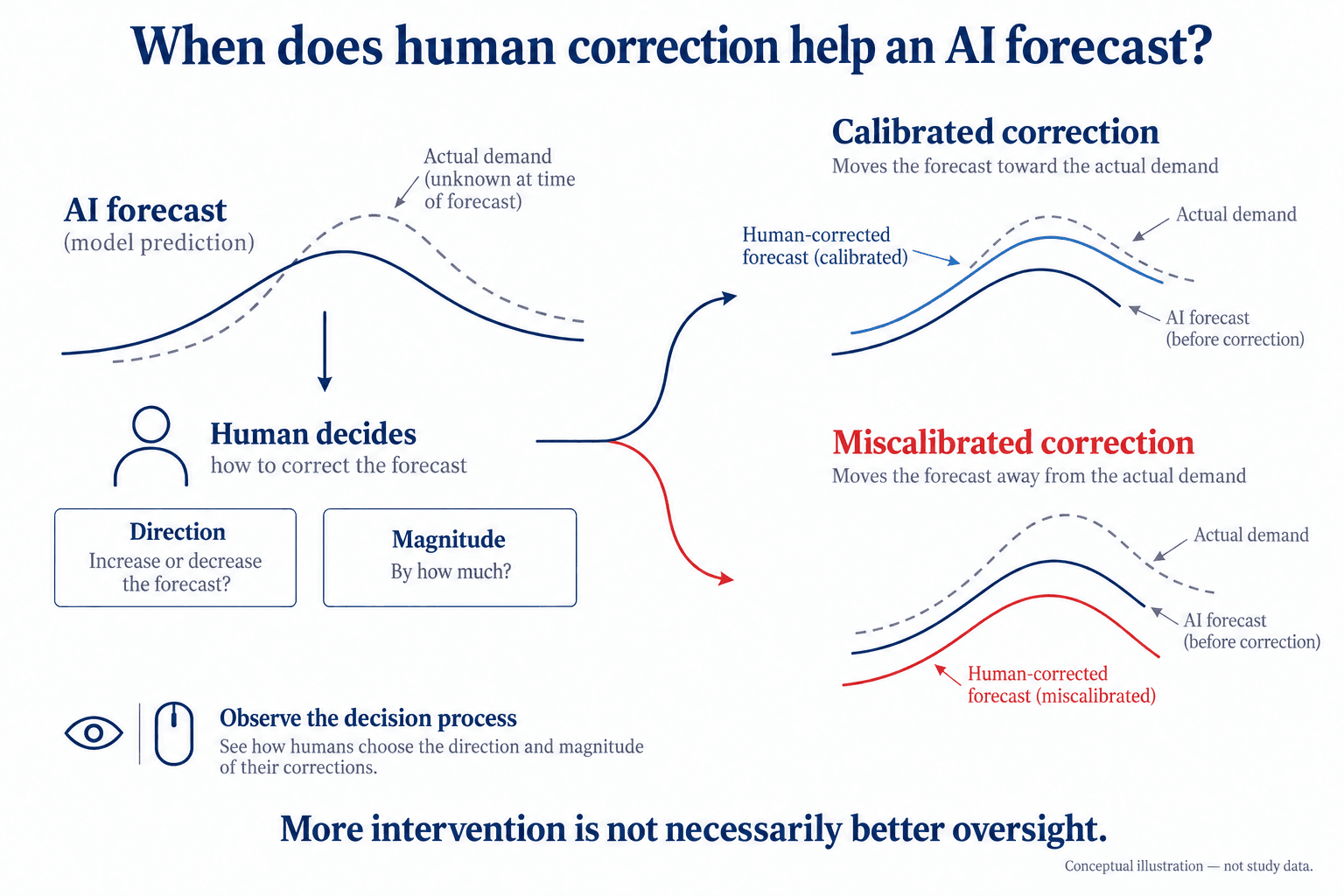
One-line summary
Human oversight adds value only when both the direction and magnitude of correction are calibrated: intervening more can make an AI forecast substantially worse.
At a glance
- 01Problem
- Binary accept-or-reject measures cannot describe continuous oversight, where a user must decide whether, how far and in which direction to change an AI prediction.
- 02Context
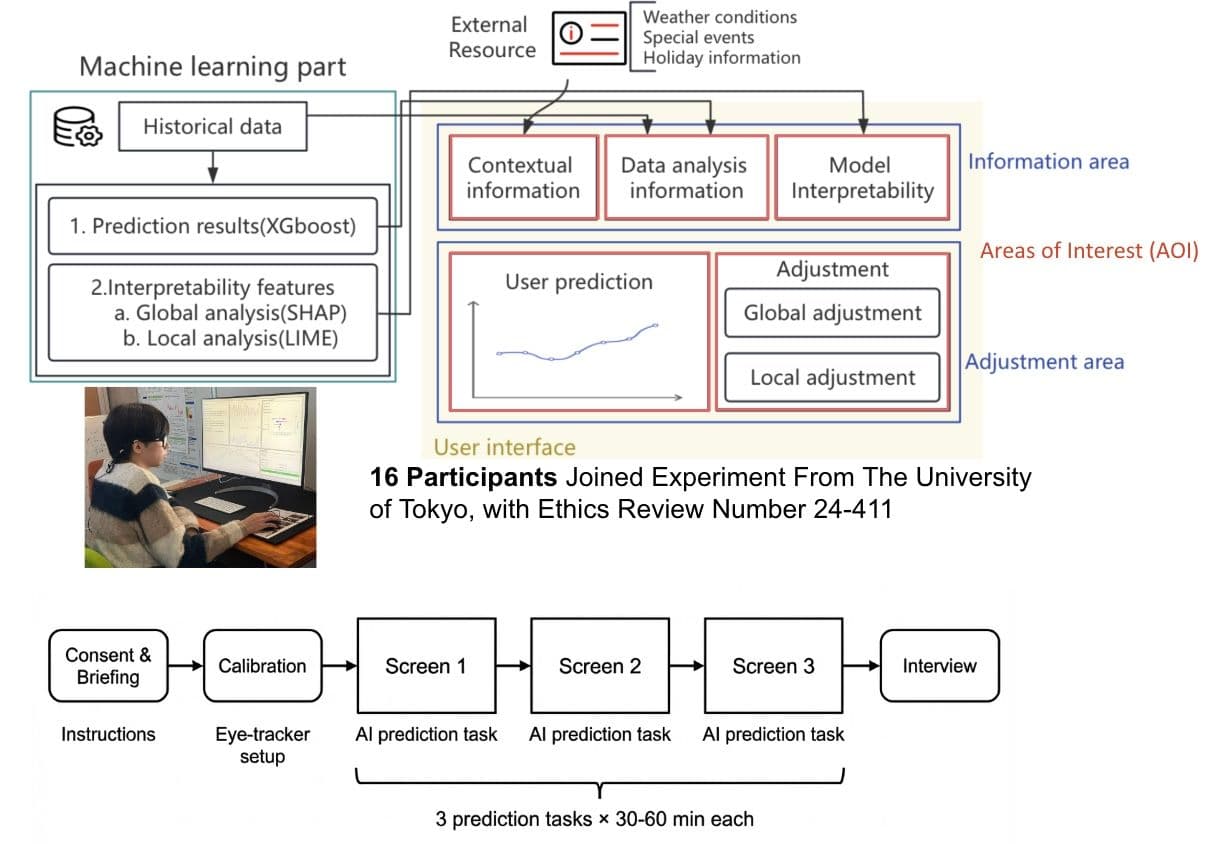
- Sixteen participants completed three AI-assisted electricity-demand forecasting tasks; the primary gaze analyses used 38 task observations from 13 participants after quality exclusions.
- 03My contribution
- As first author, I led the conceptualization, methodology, software, formal analysis, investigation, data curation, visualization and original manuscript draft.
- 04Outcome
- A two-dimensional Agency × Effectiveness framework showing that intervention intensity improves forecasts only when the correction direction is well calibrated.
Three-minute walkthrough
Why continuous correction needs a different model of reliance
Most human–AI studies reduce reliance to a binary choice: accept or reject the machine recommendation. Forecasting requires a harder form of oversight. A user can leave the AI prediction unchanged, adjust one or many hourly values, move them by different amounts and move them in either the correct or incorrect direction. The same visible act of intervention can therefore repair an AI error or add new error to an already useful forecast.
A synchronized eye-and-mouse forecasting study
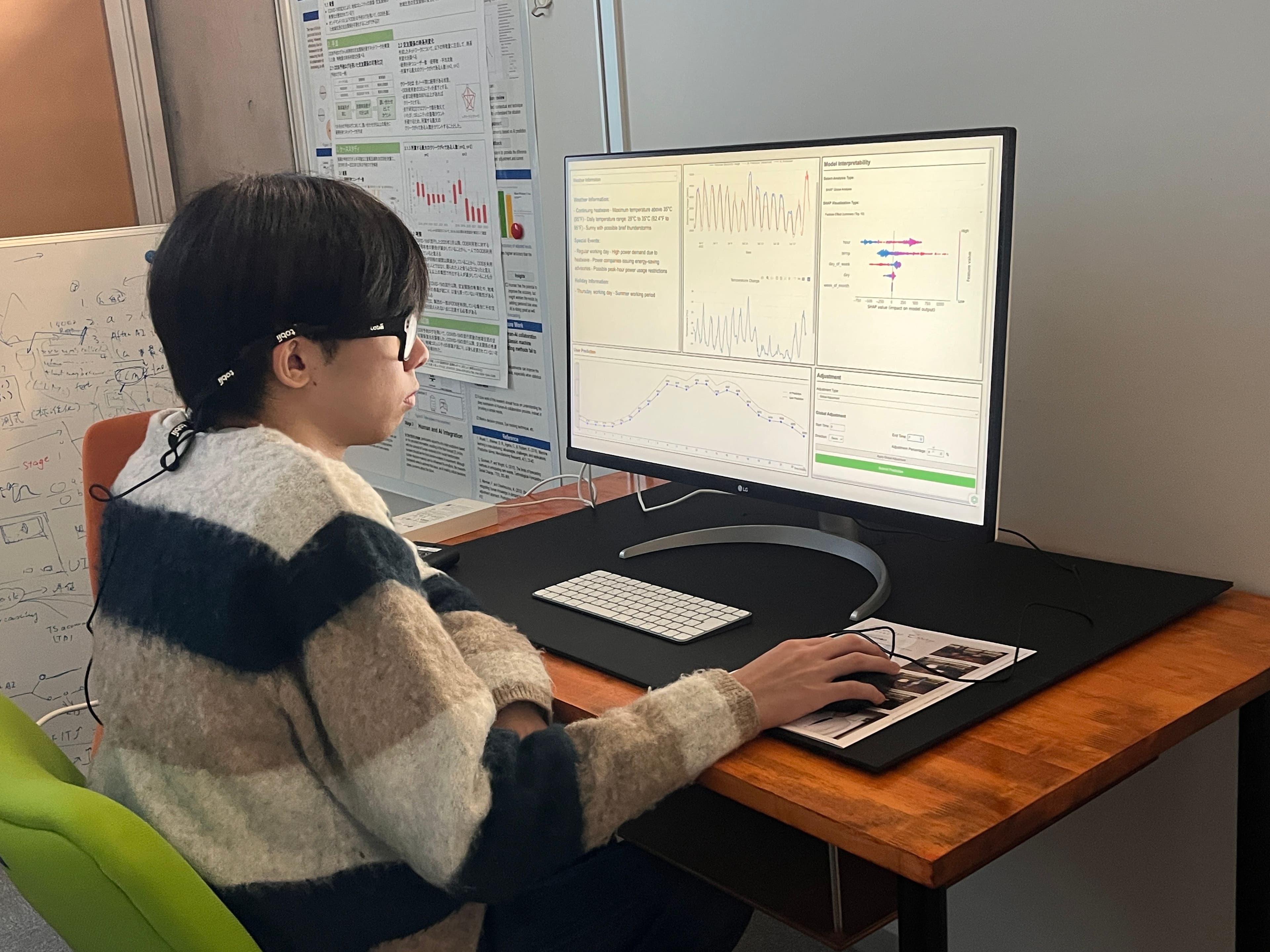
Sixteen university participants worked with an XGBoost electricity-demand model across three within-subject tasks. The interface presented contextual information, historical data, the model forecast, SHAP-based feature attributions and controls for adjusting 24 hourly values. Eye tracking and mouse interaction were synchronized so that information seeking could be aligned with the decision phases in which participants actually modified the forecast. Thirteen participants remained in the primary eye-tracking analyses after pre-defined data-quality exclusions, contributing 38 task-level observations.
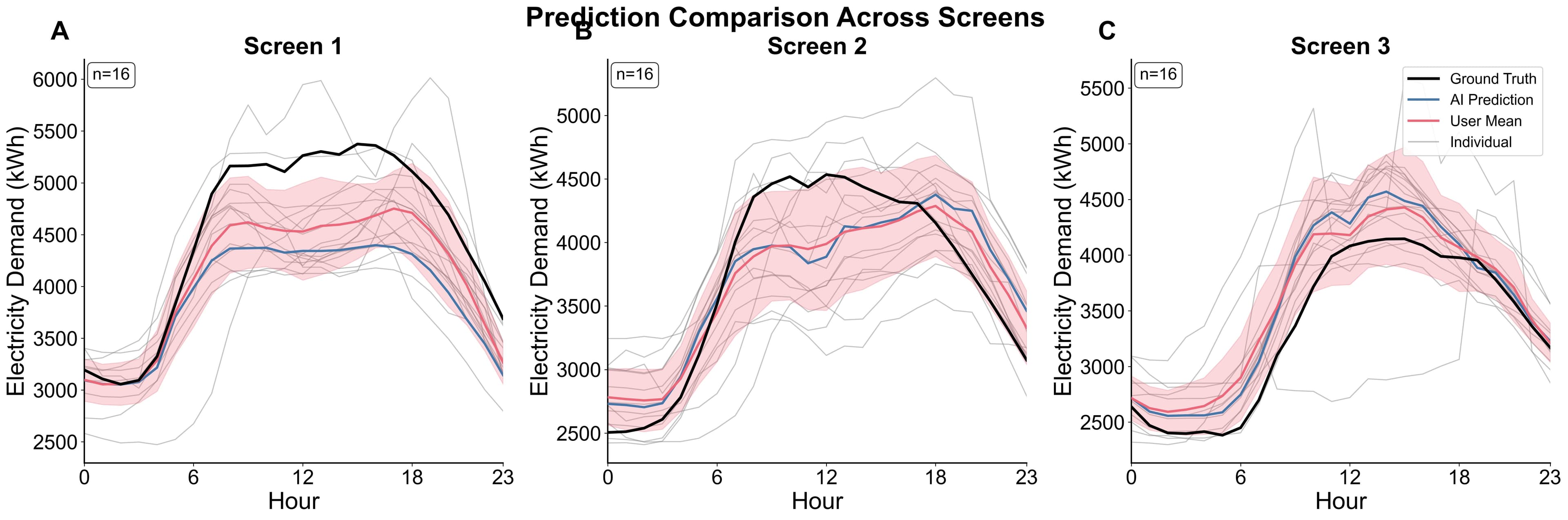
Separating how much users intervene from whether they intervene correctly
The analysis decomposed each task into three complementary quantities. Agency measures total modification intensity. Effectiveness measures the share of adjusted points moved toward the ground truth. Forecast Value Added (FVA) compares the final user forecast with the original AI baseline. Keeping these quantities separate avoids treating activity itself as evidence of useful oversight.
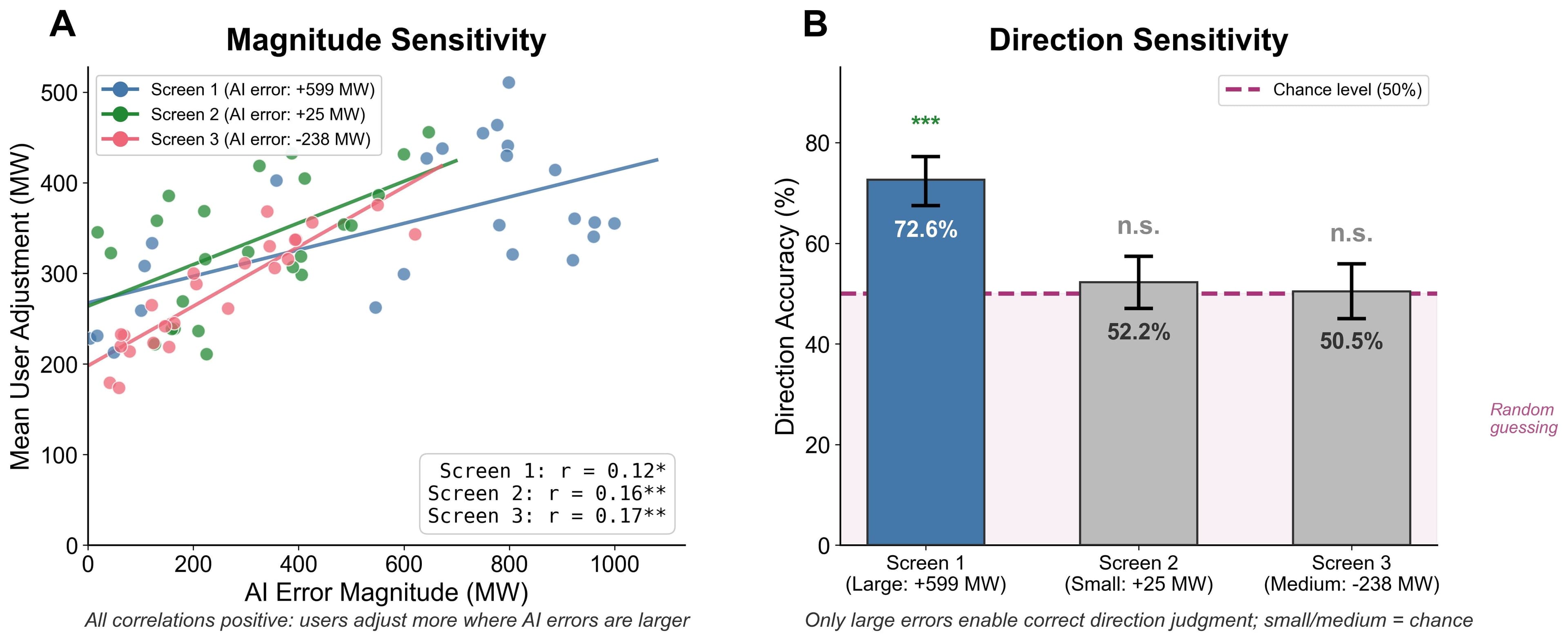
Users sensed error magnitude better than correction direction
Across all three tasks, participants adjusted more where AI errors were larger. That magnitude sensitivity did not imply directional calibration. Direction accuracy exceeded chance only on Screen 1, where the AI made a large and systematic error. Screens 2 and 3 remained statistically indistinguishable from random direction guessing even though participants continued to intervene.
Collaboration strategy was a task-contingent state, not a fixed user type
Combining Agency and Effectiveness produced four observable strategy states: Effective Collaboration, Over-intervention, Conservative Correct and Passive Ineffective. The same participant often occupied different states on different tasks. Ten of thirteen participants switched quadrant at least once, cautioning against permanent labels such as an inherently trusting or interventionist user.
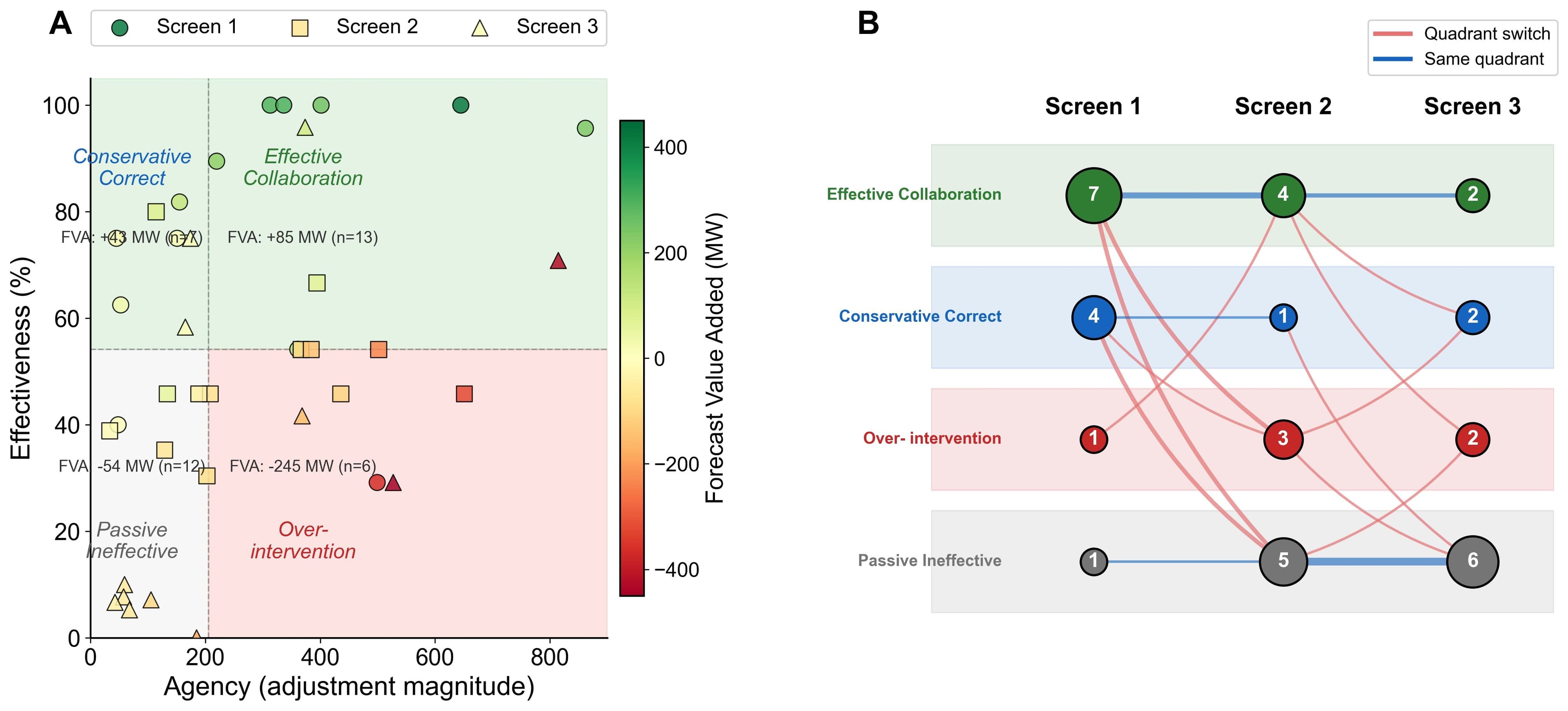
More intervention helps only when the correction is calibrated
The primary mixed-effects model found a significant Agency × Effectiveness interaction (β = 0.016, p < .001, 95% CI [0.011, 0.021]). At high Effectiveness, stronger intervention was associated with positive FVA. At low Effectiveness, the same increase in Agency made outcomes worse. Temporal separation, permutation and bootstrap checks supported the interaction beyond a shared-measurement artifact.
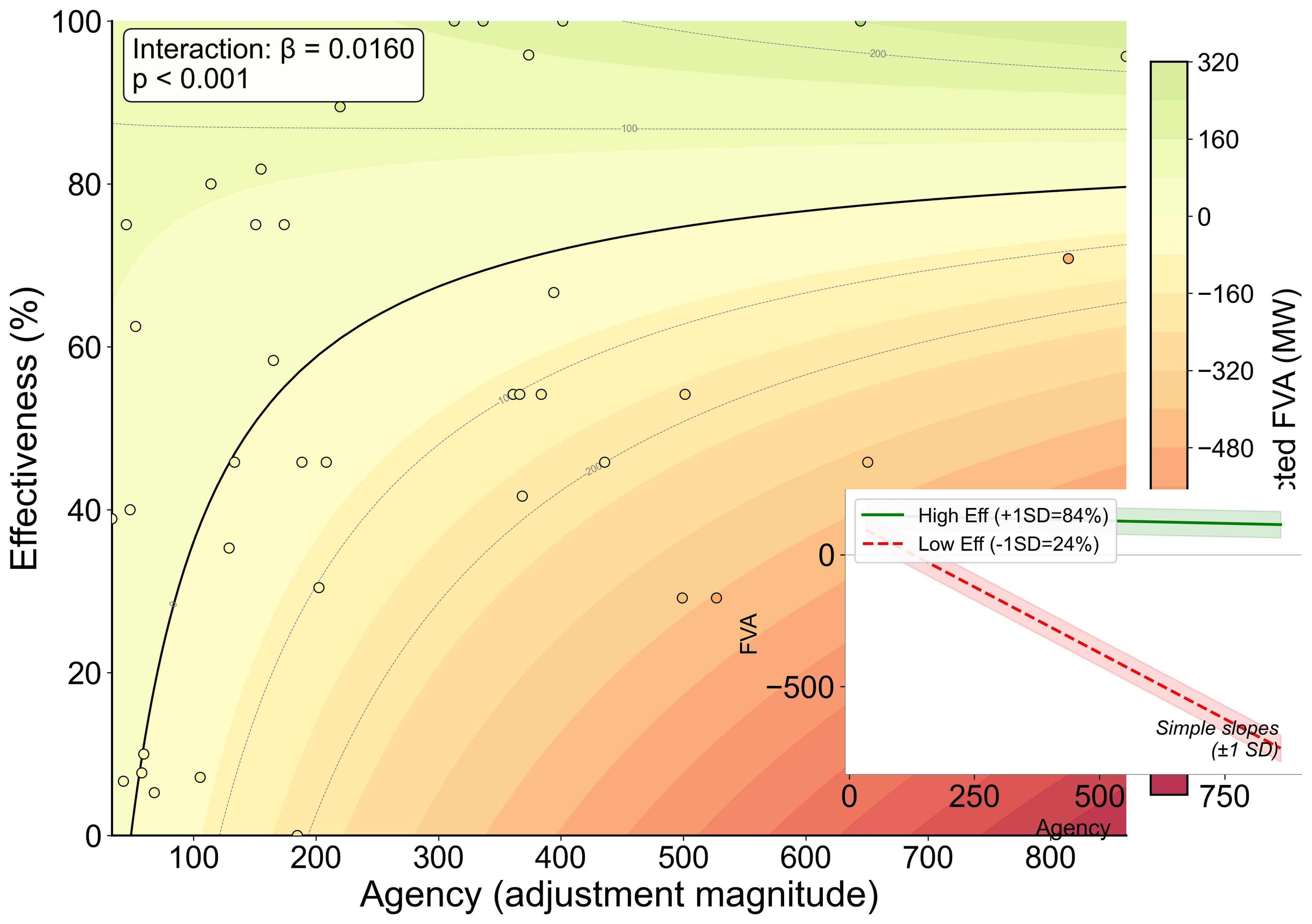
Gaze marked willingness to act—not whether the action would be correct
Phase-aligned eye tracking provided process evidence immediately before and during intervention. Greater pre-decision information dwell, broader AOI exploration and shorter mean fixations were associated with higher Agency after controlling for task. None of these aggregate gaze measures showed a reliable association with Effectiveness. The study therefore does not claim that gaze predicts correction quality.
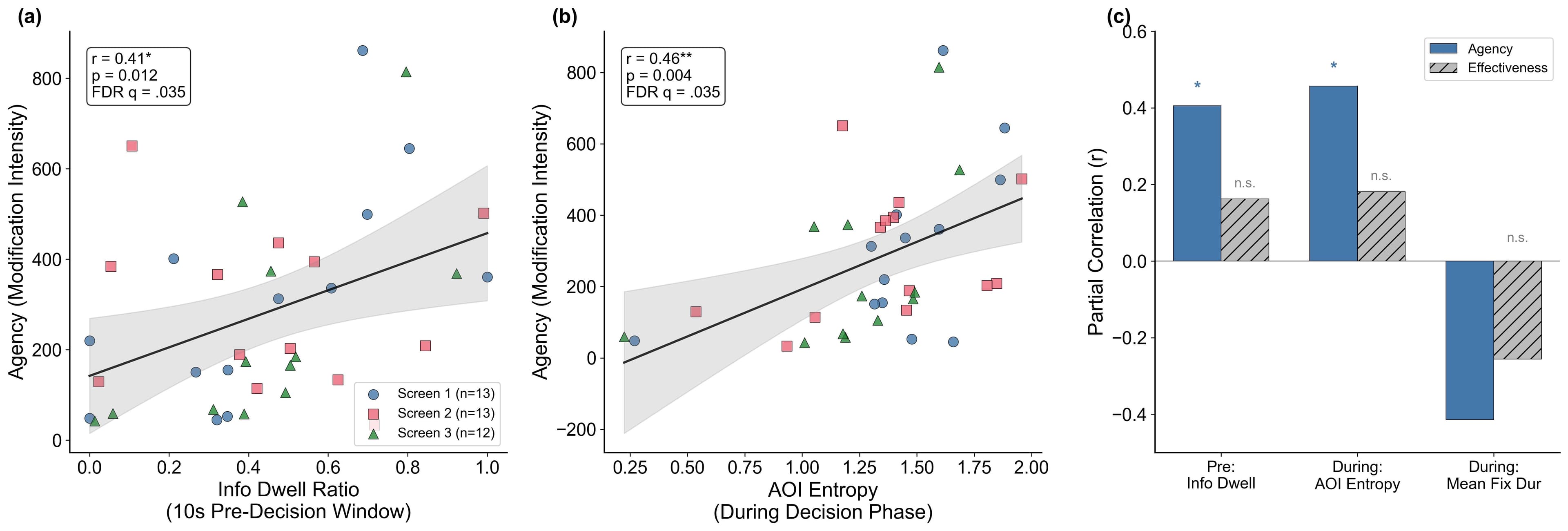
Making explanations available did not make them part of the workflow
Participants spent about 15% of gaze time on the Model Interpretation panel. The dominant transition was directly from Data to Action: 59% of transitions leaving Data entered the action area. Although 25% moved from Data to Model, the complete Data → Model → Action trigram represented only 1.9% of all transition sequences. Explanation exposure alone was not reliably associated with Effectiveness or FVA.
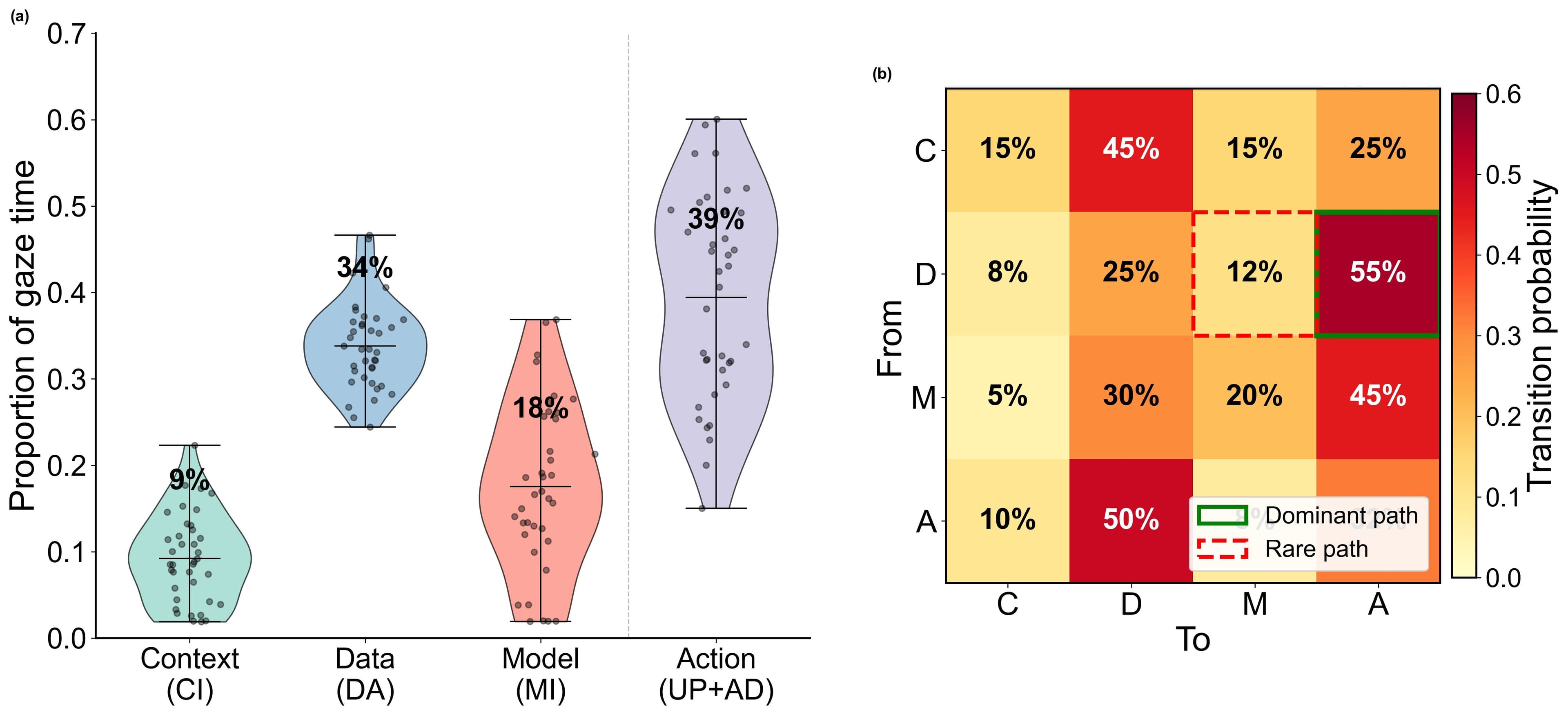
Design implication: support calibration, not intervention for its own sake
The findings motivate interfaces that separate the direction decision from the magnitude decision, surface uncertainty or directional cues at the moment of action and adapt support to the user’s current collaboration state. Explanations should be integrated into the correction workflow rather than placed in a passive panel and assumed to influence behavior. These proposals remain design implications to test, not evaluated product effects from the present study.
What this evidence does—and does not—establish
The fixed order of the three tasks confounds task characteristics with learning or fatigue, even though screen controls and within-screen checks support the primary interaction. The university-student sample and single forecasting domain limit generalization to experts and other high-stakes settings. Associations between gaze and intervention are correlational, and the available sample could not rule out smaller gaze–Effectiveness relationships. The evidence supports calibrated intervention as an analytical framework; it does not show that eye tracking can determine whether a future correction will be right.
Acknowledgements
The authors thank the SECOM Science and Technology Foundation for facilitating participant recruitment.